
One building, one blast, more than 45 dead—yet no one in power is in a hurry to explain why a warehouse of mining explosives sat next to people’s homes in a Myanmar war zone.
Story Snapshot
- A midday explosion at a suspected mining-explosives depot near Myanmar’s border with China killed over 45 people and injured about 70 others [1][2]
- Rescuers describe children among the dead, hundreds of nearby homes damaged, and bodies rushed straight to cremation [1]
- The blast hit territory held by an ethnic armed group, where the central government and regulators barely reach [1]
- No one has publicly taken responsibility, leaving families and observers with casualties—but not answers [1][2]
A warehouse full of explosives and a village that never stood a chance
Rescue workers say the building that blew apart stood in Kaungtup village in Namkham township, a few miles south of the Chinese border in northeastern Myanmar, and it was said to store explosives for mining operations in the area [1][2]. The blast hit around noon, when villagers were going about ordinary Sunday routines, not hiding in bunkers. That timing matters: whoever stacked volatile materials in that warehouse effectively gambled with an entire community’s lunch hour.
Blast at a building in northeastern Myanmar, reportedly storing explosives for mining, has killed more than 45 people – rescuers pic.twitter.com/vsfFkLw5cJ
— TRT World Now (@TRTWorldNow) May 31, 2026
Reports from the ground describe a scene that looks less like an industrial mishap and more like a battlefield aftermath: one rescuer counted 46 bodies, including six children, recovered by evening and taken directly for cremation, while roughly 74 wounded were sent to the township hospital [1]. Another rescuer estimated about 40 killed and said more than 100 nearby houses were damaged [1]. When casualty counts vary at that scale, the only sure thing is that the explosion was powerful enough to erase precision.
Life, death, and mining explosives in a lawless corner
The blast site lies in territory controlled by the Ta’ang National Liberation Army, an ethnic armed group locked in conflict with Myanmar’s central government [1]. That political fact explains why you have rescuers talking, but not regulators. When armed groups run the ground and the state is either absent or at war with them, safety codes and inspections become theory, not practice. Common sense says high explosives and weak governance are a lethal combination; this village just proved the point.
Accounts consistently describe the structure as a building “said to have been storing explosives for mining,” yet no official record has surfaced showing who owned the materials, whether they were licensed, or how much was there [1][2]. That “said to have” phrase is doing heavy lifting. It tells you locals knew the building was not a bakery, but also that no one has produced an inventory, permit, or inspection report. That vacuum of paperwork is the hallmark of a gray economy that flourishes when the rule of law retreats.
The facts we have, the facts we do not, and why that gap matters
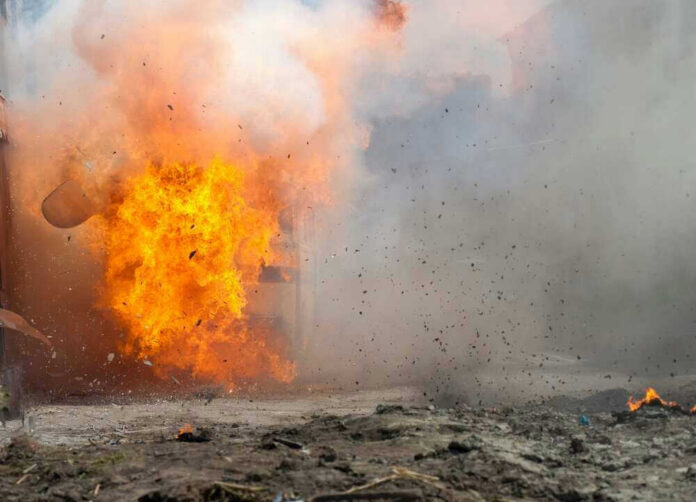
On the factual side of the ledger, the picture is clear enough to be disturbing: multiple outlets describe more than 45 dead, around 70 injured, and a structure associated with mining explosives that detonated inside a populated village [1][2]. Rescue workers and independent media agree on the basic outline, and video on social platforms shows a massive fireball consistent with a large explosives cache. This is not rumor-level smoke; it is carnage-level fire.
Yet the cause of ignition remains opaque. No one can publicly say whether this was an accident, sloppy storage, deliberate sabotage, or some external strike [1][2]. That uncertainty matters, but it does not let anyone off the hook. Storing powerful explosives close enough to flatten homes and kill children on a Sunday afternoon is a policy choice, not an act of God. A society that takes basic safety seriously does not leave that kind of risk hanging over civilians—war zone or not.
Accountability in a world that prefers plausible deniability
Myanmar authorities have not issued a detailed explanation, and the operator behind the explosives has not stepped forward with records, safety logs, or even a statement of condolence in the publicly available reporting [1][2]. That silence serves power well. When no one admits ownership, no one has to answer why a warehouse of mining explosives sat in the middle of a community, or whether anyone warned residents about the risk. This is classic “govern by omission”: do nothing, say nothing, hope the world moves on.
From an American perspective, the lesson is not abstract. Put critical, dangerous infrastructure in private hands, by all means—but insist on transparent responsibility, enforceable safety rules, and clear lines of liability. When those disappear, the incentives tilt toward cheap shortcuts and away from human life. Whether in Myanmar, China, or any mining belt, the lack of basic accountability ensures that the next “mysterious” blast will not be an anomaly; it will be an appointment on the calendar.
Sources:
[1] Web – Rescuers say a blast at a building storing explosives in Myanmar has …
[2] Web – More than 45 killed, around 70 injured in blast at explosives storage …