

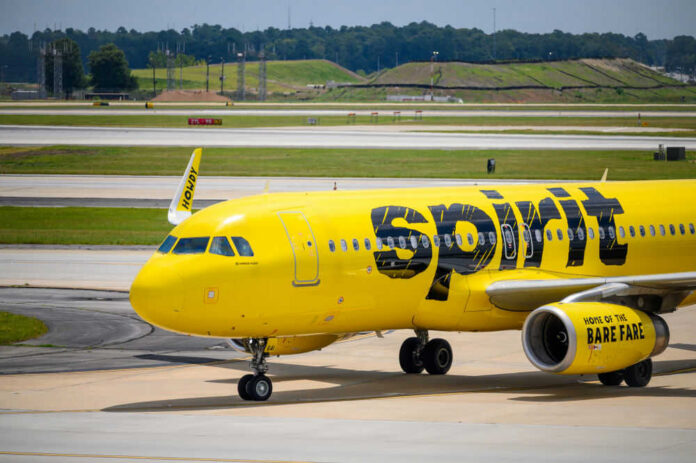
The era of fifty-dollar flights across America died at three o’clock on a Saturday morning when Spirit Airlines pulled the plug on 34 years of no-frills flying, stranding passengers and putting up to 17,000 employees out of work after bondholders rejected a half-billion-dollar government lifeline.
Story Snapshot
- Spirit Airlines ceased all operations May 2, 2026, after failing to secure a $500 million federal bailout from the Trump administration
- Bondholders including Citadel and Ares Management blocked the rescue deal, calling the airline unsalvageable despite government willingness to take a 90% equity stake
- Surging jet fuel costs from the Iran war combined with $2.5 billion in pandemic losses drained Spirit’s remaining cash reserves
- Between 7,500 and 17,000 jobs disappeared overnight, ending the largest ultra-low-cost carrier’s dominance in discount air travel
- Budget travelers face higher fares as competitors consolidate the market and the ULCC business model faces existential questions
When Creditors Said No to Uncle Sam
The Trump administration pushed hard for the Spirit rescue, with the president himself reportedly pursuing the deal like a “dog on a bone” according to sources close to the negotiations.
Transportation officials crafted a proposal offering $500 million in emergency loans in exchange for government equity warrants that would have given taxpayers a 90% ownership stake in the restructured carrier. Two of three creditor groups supported the framework, seeing potential value in keeping the airline operational.
But the third group, including heavyweight bondholders like Ken Griffin’s Citadel and Ares Management, delivered a blunt assessment that sealed Spirit’s fate: you cannot breathe life into a corpse.
The rejection landed on May 1, hours before Spirit executives notified the administration they would begin an orderly wind-down within 24 hours. President Trump’s final public comment reflected the deal-making pragmatism that defined the talks, stating he would only support a proposal “if it’s a good deal” for American taxpayers.
By 2 a.m. Eastern Time on May 2, Spirit Aviation Holdings posted the shutdown notice on its website, instructing passengers not to come to airports and warning that refunds, especially for debit card purchases and loyalty points, remained uncertain.
How Geopolitics Grounded the Yellow Planes
Spirit entered 2026 already crippled by two bankruptcy filings and years of hemorrhaging cash, but the Iran conflict delivered the knockout punch. United States and Israeli military strikes on Iranian targets escalated sharply on February 28, 2026, disrupting global oil markets and doubling jet fuel prices within weeks.
For an ultra-low-cost carrier operating on razor-thin margins where fuel represents roughly 30% of operating costs, the price spike proved catastrophic. Spirit had already cut 4,000 jobs and 200 routes throughout 2025, ending the year with approximately 7,500 employees and dwindling cash reserves that evaporated as fuel bills soared.
Spirit Airlines shuts down after failing to reach a bailout deal, ending discount travel erahttps://t.co/CpagP3IZz6
— Gladiator (@EpicTradeDate) May 2, 2026
The airline’s troubles predated the geopolitical crisis by years. Spirit lost $2.5 billion since 2020 as the pandemic devastated travel demand, forcing the first Chapter 11 bankruptcy filing in November 2024.
A proposed merger with JetBlue, announced in 2022, collapsed after Justice Department antitrust objections blocked the deal in 2024, eliminating Spirit’s best exit strategy. The second bankruptcy filing in August 2025 came with management’s stark admission of “substantial doubt” about the company’s ability to continue operations.
Post-pandemic consumer behavior shifted toward full-service carriers offering more amenities, undermining Spirit’s fee-driven business model that generated over 90% of revenue from add-on charges for everything from seat selection to carry-on bags.
The Human Cost of Discount Aviation’s Demise
Thousands of Spirit employees reported for work Friday expecting a resolution, only to face sudden unemployment by dawn Saturday. The workforce included approximately 2,000 pilots and 3,000 flight attendants, many based in Florida where Spirit maintained major operational hubs.
No union safety net appeared in crisis coverage, leaving workers scrambling for positions at competitor airlines already staffed for current demand. Airports like Newark witnessed scenes of confusion as passengers arrived for flights that would never depart, clutching tickets now worthless except as potential claims in bankruptcy court.
Travel industry expert Henry Harteveldt warned passengers who paid with debit cards or planned to use loyalty points face the bleakest refund prospects, as these payment methods typically receive lowest priority in bankruptcy liquidation.
Competitors including JetBlue and Frontier stepped in with rebooking assistance, though at significantly higher price points than Spirit’s trademark ultra-low fares.
The shutdown removes roughly $3 billion in annual revenue from the aviation market and eliminates crucial competition that kept legacy carriers’ pricing in check on hundreds of routes connecting smaller cities to major destinations.
What Spirit’s Death Means for Your Next Flight
The immediate market impact concentrates among budget-conscious travelers who relied on Spirit’s bargain fares to afford air travel. Rural and economically disadvantaged communities lose vital connectivity as remaining ultra-low-cost carriers like Frontier and Allegiant face reduced competitive pressure to maintain aggressive pricing.
Industry analysts predict a wave of consolidation among surviving discount carriers, potentially through mergers that further reduce consumer choice. The used aircraft market will absorb Spirit’s fleet liquidation, though the fire-sale prices may benefit competitors seeking rapid expansion to capture Spirit’s abandoned routes and customer base.
Spirit’s collapse raises fundamental questions about the viability of the ultra-low-cost carrier model during periods of volatility. The business structure depends on absolutely predictable fuel costs, maximum aircraft utilization, and consumers willing to tolerate minimal service for rock-bottom prices.
When any element fails, especially fuel price stability, the entire equation collapses because ULCC operators lack the premium revenue streams that help full-service carriers weather turbulence.
The Bailout That Wasn’t
The Trump administration’s willingness to consider the Spirit rescue represents a notable shift from typical opposition to corporate bailouts, justified by officials as protecting American jobs during a geopolitical crisis.
Transportation Secretary Duffy characterized the government’s effort as “extraordinary,” emphasizing the administration explored every viable option before accepting failure.
Yet the bondholders’ rejection underscores a harsh financial reality that transcends political ideology: no amount of government capital can salvage a business model fundamentally broken by structural cost pressures and evaporated market demand.
The creditors who blocked the deal hold legitimate claims to Spirit’s remaining assets and owed fiduciary duties to maximize recovery value rather than gamble on a long-shot revival.
Comparing this situation to the 2020 CARES Act airline bailouts reveals critical differences. That pandemic relief supported fundamentally healthy carriers facing a temporary demand crisis with clear recovery prospects once travel resumed.
Spirit in 2026 faced permanent shifts in consumer preference, unresolved bankruptcy obligations, and ongoing fuel costs that exceeded revenue-generating capacity even at full operation. The creditors’ grim assessment, however callous it sounds, reflects sober analysis rather than ideological opposition to government intervention.
Sometimes businesses fail because they should fail, and prolonging the inevitable with taxpayer money serves neither economic efficiency nor common sense.
Sources:
Spirit Airlines shutting down after failed effort at government bailout – CBS News
Spirit Airlines shutting down after rescue talks collapse – The Independent