
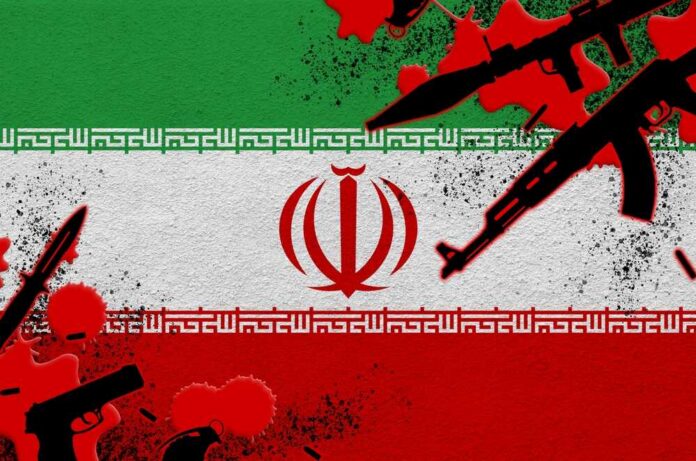
While a fragile ceasefire spares Iran from bombardment, the regime’s war against its own people has intensified to a chilling crescendo of executions, asset seizures, and state-sanctioned terror.
Story Snapshot
- Iran executed at least 10 political prisoners during the recent war period, with executions accelerating into what human rights monitors call a “deeply alarming phase”
- Judiciary seized assets of over 400 diaspora journalists and artists on April 11, weaponizing property confiscation to silence critics abroad
- Police Chief Gen. Ahmad-Reza Radan declared “our hand is on the trigger” in March, threatening lethal force against protesters
- Internet blackouts continue suppressing evidence of mass arrests, torture, and enforced disappearances targeting dissidents including children as young as 14
Terror From Tehran to London
Shiva, a journalist working in London, received an ominous message in April: Iran’s judiciary had confiscated her family’s property back home. She belongs to a group of over 400 diaspora Iranians—journalists, artists, activists—whose assets the regime seized under newly invoked anti-espionage laws.
The regime’s reach extends thousands of miles beyond its borders, using family wealth as leverage to silence voices that expose its brutality.
Meanwhile, streets in Iranian cities remain militarized with IRGC troops, Basij militia, and plain-clothes agents manning checkpoints while state propaganda blares from loudspeakers.
Execution Assembly Line Accelerates
Amirhossein Hatami was 18 years old when authorities executed him on April 2 for participating in the January protests. His death exemplifies what the Human Rights Activists News Agency called a “new alarming phase” of accelerated executions.
Just days later, authorities executed Mohammadamin Biglari and Shahin Vahedparast for allegedly attempting to raid an armory during January demonstrations.
Between January 5 and 14 alone, HRANA documented 52 executions. The pace represents a calculated escalation from the regime’s 2022 Women, Life, Freedom crackdown, which saw execution rates hit decades-high levels.
Iran escalates crackdown on dissent as arrests, executions and threats surge, observers say – ABC News via @ABC – https://t.co/iCZ4Vp4Qg7
— Woodrow Williams (@Woodrow17165268) April 20, 2026
Blueprint for Suppression
Supreme Leader Ali Khamenei set the tone on January 3, ordering security forces to handle protesters with an iron fist and labeling demonstrators as “rioters.”
Police Chief Radan’s March 11 threat materialized into documented atrocities: security forces deployed rifles and shotguns loaded with metal pellets aimed at heads and torsos.
Amnesty International collected videos and eyewitness accounts confirming lethal force, mass arrests sweeping up children, enforced disappearances, and systematic torture, including sexual assault and chemical injections. The judiciary’s April 5 directive demanding “no leniency” and expedited trials formalized what activists already witnessed.
Internet shutdowns beginning January 8 serve a dual purpose: concealing evidence of atrocities while paralyzing protesters’ ability to coordinate. The regime learned from previous uprisings that controlling the flow of information matters as much as controlling the streets.
State media outlets like Mizan News Agency frame executions as justified responses to “mass murder plots” and “collaboration with enemies,” inverting reality while rights groups document unfair trials conducted at breakneck speed.
Erfan Soltani’s case exemplifies the regime’s judicial farce—arrested and executed within days in January with no meaningful due process.
War as Cover for Domestic Terror
The late February outbreak of war between Iran and a U.S.-Israeli coalition provided perfect cover for escalating domestic repression. While international attention focused on military strikes, the regime massacred protesters in March and ramped up executions throughout the conflict.
The April ceasefire brought no relief for Iranians facing their government’s wrath. Activist Zia Nabavi captured the compound crisis: “Tyranny, war, sanctions, executions—tools for destruction.”
The regime appears intent on crushing any opposition while exploiting wartime conditions to justify extremism under the banner of fighting foreign enemies.
Iran escalates crackdown on dissent as arrests, executions and threats surge, observers say
Iranians and observers describe what they say is a continued crackdown in Iran. https://t.co/sJTFY9xvaE— Steve Williams (@HISteveWilliams) April 20, 2026
The crackdown’s trajectory suggests a regime increasingly desperate to maintain control through fear. Asset confiscations targeting diaspora communities reveal strategic calculation—attacking expatriate critics while pressuring their families creates a climate where speaking out carries devastating consequences regardless of physical location.
This represents an evolution from prior repression patterns, extending the regime’s authoritarian reach globally while intensifying domestic violence against its own citizens.
The question looming over Iran’s 90 million people is whether intensified brutality can indefinitely suppress the fundamental human desire for freedom and dignity.
Sources:
What happened at the protests in Iran? – Amnesty International
2026 Iran massacres – Wikipedia