

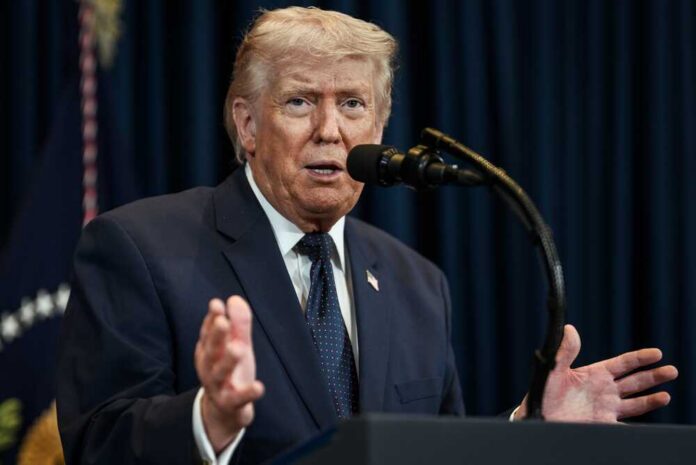
BREAKING UPDATE: TRUMP HAS CANCELED TODAY’S CAMP DAVID MEETING AND WILL HOLD IT AT THE WHITE HOUSE.
When the President quietly moves his entire Cabinet to Camp David, the world should pay attention — because the last time that happened, history changed.
Story Snapshot
- President Trump convened a rare Cabinet meeting at Camp David as Iran nuclear negotiations reached what officials described as a critical phase.
- Trump’s entire top foreign policy team huddled for hours to align U.S. strategy on the Iran nuclear crisis and the ongoing war in Gaza.
- Reports from late May 2026 indicated the United States and Iran were nearing a broader peace agreement following months of conflict and stalled diplomacy.
- Airspace over Camp David was locked down for the session, signaling the meeting carried serious security weight beyond a routine policy review.
Why Camp David Changes the Calculus
Camp David is not a conference room. It is a presidential retreat steeped in the weight of decisions that reshaped the world. Winston Churchill was among the first foreign dignitaries hosted there, and the site has anchored some of the most consequential diplomatic moments in American history. When a president moves his Cabinet there instead of convening in the Situation Room, the signal to allies, adversaries, and intelligence services worldwide is unmistakable: this is not routine business.
Trump convened the session as negotiations with Iran entered what his administration publicly described as a critical phase. Trump himself said talks were proceeding “nicely,” though the decision to pull his entire national security apparatus out of Washington and into a locked-down presidential retreat tells a more urgent story than that word choice suggests. Airspace closures do not accompany routine optimism.
The Iran Timeline That Brought Everyone to the Table
The road to this Cabinet session was neither smooth nor short. Trump had previously set a 60-day deadline for Iran to reach a nuclear agreement. That deadline passed without a deal, and Israel subsequently launched multiple strikes against Iranian targets.
By late May 2026, reports indicated the two countries were finally nearing a broader peace framework after months of conflict and stalled talks. The Camp David meeting landed squarely inside that fragile window, when the next wrong move could collapse whatever progress had been made.
President Trump is expected to take the unusual step of holding a Cabinet meeting at Camp David on Wednesday, The Washington Times has confirmed. https://t.co/CDCGgU4fnr
— The Washington Times (@WashTimes) May 26, 2026
Trump’s foreign policy team spent hours working through U.S. strategy on both the Iran nuclear crisis and the Gaza war simultaneously. These are not separate files — they are deeply entangled. Any agreement with Iran carries implications for Hezbollah’s posture, Hamas’s leverage, and Israel’s willingness to hold a ceasefire. Getting the sequencing right requires the kind of extended, face-to-face strategic alignment that a forty-five-minute Situation Room briefing simply cannot accomplish.
Reading the Signal Without Overreading the Venue
Skeptics are right to note that Camp David’s symbolic weight can be overread. The White House itself describes the retreat as a presidential residence used extensively to host foreign dignitaries, which means the location alone does not confirm a breakthrough, a crisis, or a policy pivot. No official agenda or post-meeting readout was released publicly. Reporters, working under deadline pressure, often have to infer significance from venue, schedule, and anonymous sourcing rather than confirmed decisions.
Trump to convene rare Camp David Cabinet meeting amid rising Iran tensionshttps://t.co/30R04msxcO
— ABC 33/40 News (@abc3340) May 26, 2026
That caution is fair, but it cuts both ways. The absence of a public readout is itself a data point. Administrations release readouts when they want credit for progress. When they go quiet after a high-profile gathering, it typically means the negotiations are live and fragile, and that premature disclosure could blow them up. Silence from Camp David, in this context, is not nothing — it is arguably the most disciplined signal the administration could send to Tehran that the United States is serious and still at the table.
What Happens If a Deal Actually Lands
A genuine U.S.-Iran nuclear agreement would be one of the most significant foreign policy achievements of any administration in a generation. It would reshape energy markets, alter the strategic calculus for every Gulf state, and force a reassessment of U.S. force posture across the entire Middle East. It would also be politically transformative at home.
Trump staked enormous credibility on his maximum-pressure approach and his insistence that his predecessor’s framework was a failure. A deal struck on his terms would be a validation of that bet — and his critics know it.
The Camp David meeting may prove to be the moment historians point to, or it may prove to be one more intense session in a long and grinding process. What it is not, by any reasonable reading, is routine. When the entire foreign policy Cabinet goes off-campus, locks down the airspace, and spends hours in closed deliberation, something real is being decided. The only question still open is whether the outcome holds.
Sources:
[1] Web – Trump calls rare Camp David Cabinet meeting amid critical Iran talks
[2] Web – 2025–2026 Iran–United States negotiations – Wikipedia
[3] Web – Camp David – The White House
[4] Web – Trump to hold Cabinet meeting at Camp David on Wednesday
[5] Web – Trump discussed Gaza, Iran goals at Camp David strategy session