
Ten school employees walked out of a Bakersfield office building alive early Wednesday morning because the Federal Bureau of Investigation (FBI) put a bullet in the man who had wired explosives to their bodies and held them captive for 15 hours.
Story Snapshot
- A man with a violent criminal history and sex offender status seized 10 school district employees inside a Bakersfield, California Chase Bank building Tuesday afternoon.
- The suspect claimed to have explosives and had devices visibly attached to his person; FBI agents confirmed the threat through their own observations.
- Negotiations lasted more than 15 hours, two hostages were released during talks, and the remaining eight were freed after the FBI fatally shot the suspect.
- All 10 hostages were recovered unharmed, though some had been tied up and at least one required diabetic medication during the ordeal.
How a Bomb Threat Became a 15-Hour Siege
Officers responded to a bomb threat at the Chase Bank building in downtown Bakersfield around 1 p.m. Tuesday and found a barricaded suspect who had taken 10 people hostage. [1] The suspect was 41 years old, had a documented history of violence, and was a registered sex offender, according to FBI Special Agent in Charge Sid Patel. [1]
Those facts alone told law enforcement they were not dealing with a desperate first-time offender looking for a way out. They were dealing with someone who had already demonstrated a willingness to harm people.
The explosive threat was not a bluff law enforcement could afford to call cheaply. The suspect had devices visibly attached to his person and claimed additional explosives were fastened to some of the hostages themselves. [1]
FBI agents confirmed those claims through their own observations, which means negotiators were managing a scenario where a single wrong move could have killed everyone in that building simultaneously. Two hostages were eventually released during the overnight negotiations, a sign that talks were producing some movement, but the core standoff held. [1]
The Moment Negotiations Stopped Working
Crisis negotiation teams worked the phones for more than 15 hours. [1] That is not a short conversation. That is a sustained, exhausting attempt to find a peaceful exit. The fact that the FBI ultimately fired tells you the talks reached a point where waiting was no longer a neutral act.
What the public record does not yet show is the precise moment-by-moment sequence that triggered the shot. No body-camera review, no tactical timeline, and no after-action report has been released. [2] That gap matters, and anyone who tells you the shooting was obviously justified or obviously excessive is working from incomplete information.
#Breaking FBI kills man holding hostages in California. @WKRN pic.twitter.com/B8bKEa4bRs
— Megan Fee (@meganfeetv) June 3, 2026
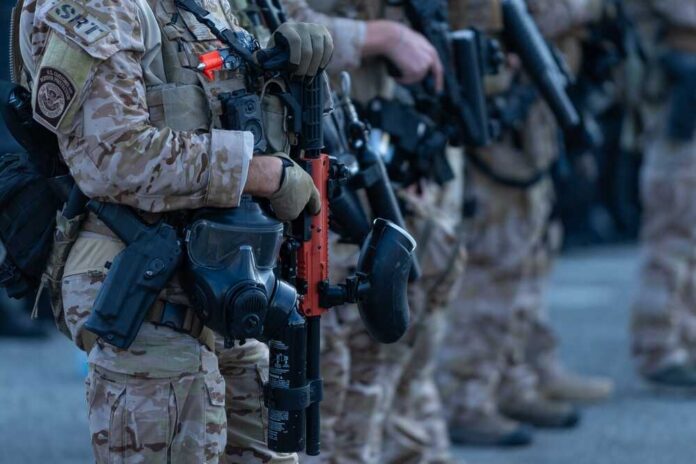
What the record does show is this: a man with explosives on his body, holding people who were tied up, one of whom needed medical attention for diabetes, refused to surrender after 15 hours of professional negotiation. [2] The FBI Hostage Rescue Team exists precisely for moments when every other option has been exhausted.
Common sense and basic threat logic suggest that a suspect wired with explosives, surrounded by bound hostages, in an enclosed building, represents an imminent mass-casualty scenario. The FBI’s judgment call appears grounded in operational reality, even if the forensic details confirming the explosive devices were real have not yet been made public.
What the Public Still Does Not Know
The open questions here deserve honest acknowledgment rather than dismissal. Were the explosive devices functional or theatrical props designed to paralyze law enforcement? Was there a specific action by the suspect that triggered the shot, or did commanders make a time-based decision? Were any hostages in the direct line of fire? [2]
These are not hostile questions aimed at second-guessing the FBI. They are the standard accountability questions that any use of lethal force by federal agents should be able to answer with documented evidence. The FBI and the Department of Justice should release the after-action review, the bomb squad forensics, and the negotiator logs.
🚨🇺🇸 FBI Hostage Rescue Team ended a 15-hr standoff in Bakersfield, California, by fatally shooting hostage-taker Anthony Scott Searles-Harris
-10 hostages held captive
-All rescued unharmed
Suspect claimed to have explosives strapped to himself & some hostages#California #sstvi pic.twitter.com/A1IpKYmnPE— GlobeUpdate (@Globupdate) June 4, 2026
The successful rescue of all 10 hostages creates a powerful psychological frame that can short-circuit scrutiny before it even begins. Everyone lived, so the decision must have been right. That logic is understandable but incomplete. Outcome does not automatically validate process.
The FBI may well have made a textbook-correct decision under extreme pressure, but the public record needs the primary-source documentation to confirm it. Until that evidence surfaces, the official account deserves reasonable credibility based on the facts available, and the unanswered questions deserve follow-up, not silence. [1][2]
Sources:
[1] Web – FBI fatally shoots a man holding hostages in a California office …
[2] Web – Suspect in Bakersfield standoff shot and killed by … – ABC7 Chicago