

Two U.S. aircraft carriers and a flood of fighter jets are surging into the Middle East as President Trump weighs strikes that could decide whether Iran’s nuclear ambitions finally hit a hard wall.
Quick Take
- The U.S. has expanded its regional posture to include at least 13 warships, additional destroyers and littoral ships, and an incoming second carrier.
- Reports cite 150+ cargo flights moving weaponry and 50+ additional jets, signaling readiness for sustained operations if Trump orders action.
- Diplomacy remains stalled after Geneva talks produced only “guiding principles,” with U.S. officials saying the sides are still far apart.
- Iran has answered with Strait of Hormuz naval drills and a more openly offensive posture from senior military leadership.
Military Posture Signals Readiness for Prolonged Action
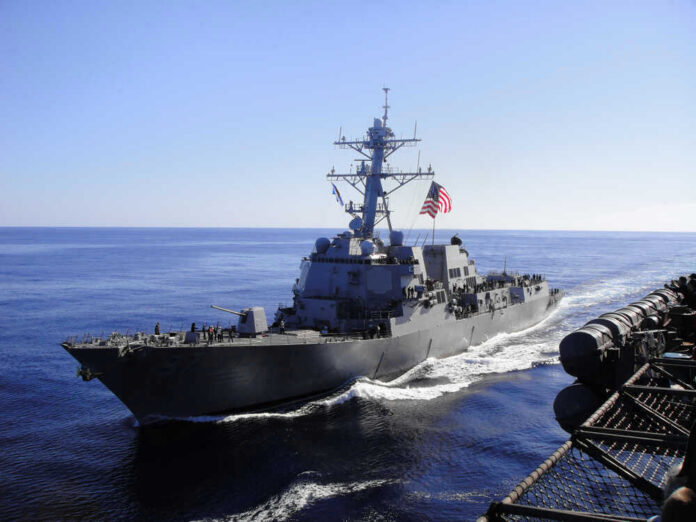
U.S. deployments now resemble a serious, layered strike-and-defense package rather than a symbolic show of force. Reporting describes at least 13 warships in the region, including the USS Abraham Lincoln carrier group, alongside multiple destroyers and littoral combat ships, with the USS Gerald R.
Ford expanded into the Middle East. The buildup includes fighter aircraft and refueling capacity—assets typically paired with sustained air operations, not one-off warnings.
The airlift component adds to the sense of operational momentum. Reports referenced more than 150 cargo flights delivering weaponry, along with the arrival of 50 additional aircraft, including advanced fighters.
That kind of throughput matters because it reduces the need to “pause” after an initial strike package, allowing commanders to replenish munitions and rotate assets quickly. U.S. officers, according to reporting, have been preparing for operations that could last weeks.
Diplomacy in Geneva Continues, But the Gap Looks Structural
Secretary of State Marco Rubio has kept diplomatic lines open while acknowledging skepticism about whether Tehran will accept the kinds of terms Washington is seeking. Geneva discussions reportedly produced “guiding principles,” yet officials indicated the parties remain far apart.
The White House has emphasized that President Trump is weighing options in a context where negotiations have not delivered a clear path to limiting Iran’s nuclear program, missile development, and regional proxy activity.
U.S. military pushes more weaponry into the Middle East for possible strikes on Iran. https://t.co/HJncQ3zVsz
— NBC News (@NBCNews) February 19, 2026
Press Secretary Karoline Leavitt publicly framed the internal debate as having “numerous arguments for a strike,” while still portraying talks as an option.
The practical issue is sequencing: when a major force package is already in motion, diplomatic deadlines can feel less like open-ended dialogue and more like a closing window.
Analysts cited in reporting warned that an extensive buildup can create momentum that becomes difficult to stop once it reaches a certain scale.
Iran’s Hormuz Moves Raise the Cost of Miscalculation
Iran has responded with actions that highlight how quickly a crisis could spill into global markets. The IRGC conducted naval drills in the Strait of Hormuz, a strategic chokepoint for energy flows, after the U.S. deployments intensified.
Iranian leadership has also telegraphed a tougher posture, including statements about an “offensive” orientation and claims of forces being ready. Those signals may be aimed at deterrence, but they also compress decision time for both sides in a fast-moving standoff.
Why This Buildup Matters to Americans at Home
For U.S. voters who watched years of foreign-policy ambiguity under prior leadership, this episode underscores a different governing approach: leverage first, then talk, with visible consequences if an adversary stalls.
The downside is that escalation carries real risks—especially to U.S. service members and to energy prices if Hormuz becomes unstable. Reporting also notes that the exact timing of any strike remains uncertain and ultimately depends on President Trump’s order.
Several facts remain difficult to verify in real time, including the precise near-term strike schedule and how Tehran would respond across proxies and maritime routes. Still, the scale of deployments—dual carriers, significant air assets, and heavy logistics—suggests planning that goes beyond messaging.
For Americans concerned about national security, sovereignty, and avoiding endless wars, the central question is whether maximum pressure can compel limits on Iran’s program without triggering the wider regional conflict everyone says they want to prevent.
Sources:
US buildup of warships and fighter jets sets stage for potential war with Iran
United States military buildup in the Middle East during the 2026 United States–Iran crisis
Iran war: Trump weighs military strikes as nuclear talks stall