
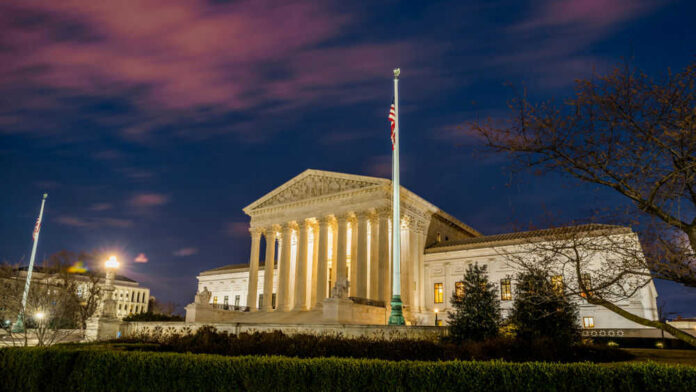
The Supreme Court just opened the door for the Trump Justice Department to erase Steve Bannon’s contempt conviction—after he already served prison time—exposing how quickly “accountability” can flip when political power changes hands.
Story Snapshot
- The Justice Department, led in court filings by Solicitor General John Sauer, asked a federal judge to dismiss Bannon’s 2022 contempt of Congress conviction in the “interests of justice.”
- Bannon was convicted for defying a subpoena from the now-defunct House January 6 committee, then served a four-month sentence in 2024.
- The unusual move seeks not only to end the case but also to wipe out lower-court rulings, potentially mooting the still-pending Supreme Court appeal.
- Judge Carl Nichols, who presided over the trial, must decide whether to grant the dismissal motion filed in the U.S. District Court in Washington, D.C.
DOJ’s dismissal bid targets a conviction that’s already been “served”
The Justice Department’s February 2026 filing asks the U.S. District Court for the District of Columbia to dismiss Steve Bannon’s contempt of Congress conviction for defying a January 6 committee subpoena.
The key twist is timing: Bannon already served a four-month prison sentence in 2024 after losing at the D.C. Circuit and failing to secure release pending appeal. The new request relies on prosecutorial discretion and frames dismissal as serving “the interests of justice.”
Bannon gets Supreme Court help in erasing contempt charges
The Trump administration said it was seeking to dismiss Bannon’s contempt charges “in the interests of justice.” @CourthouseNews https://t.co/MXsnaq9fs0
— Kelsey Reichmann (@KelseyReichmann) April 6, 2026
Because the motion is pending before Judge Carl Nichols, the outcome is not automatic. If Nichols grants dismissal, the Supreme Court appeal would likely become unnecessary, and the government has indicated it wants lower-court rulings vacated as part of effectively clearing the slate.
That may sound technical, but it matters: those opinions shape future contempt fights and define how aggressively Congress can enforce subpoenas when witnesses refuse to comply.
How the case began: a subpoena, executive privilege claims, and a narrow trial
The underlying dispute traces to an October 2021 subpoena issued by the House Select Committee investigating the January 6, 2021, Capitol attack. Prosecutors said Bannon willfully refused to provide testimony and documents.
Bannon argued he was relying on guidance tied to executive privilege, but courts rejected that line, and the trial proceeded with tight limits on defenses. A jury convicted him in July 2022 on two counts of contempt of Congress.
Federal contempt of Congress law is designed to backstop oversight with real penalties, including potential jail time and fines. In Bannon’s case, the system did what it was built to do: a subpoena was issued, a refusal led to indictment, and a conviction was affirmed on appeal.
Legal commentary around the case also stressed that certain defenses—like “advice of counsel”—generally do not excuse deliberate noncompliance once a subpoena is validly issued and enforced through the courts.
What “clears the path” actually means in practical terms
Headlines describing the Supreme Court “clearing the path” can be misunderstood. The core development in the research record is that the executive branch—through DOJ leadership—asked to dismiss, and the Supreme Court process is affected because an active dismissal bid can moot ongoing appellate review.
The district judge still must act. The practical consequence, if granted, is broader than ending one prosecution: it could erase precedential rulings that helped uphold the conviction.
Why this fuels bipartisan distrust: oversight vs. selective enforcement
Conservatives have long argued that Washington’s justice system can be weaponized, especially in politically charged cases tied to Trump-era battles. Liberals counter that reversing prosecutions of prominent Trump allies looks like preferential treatment.
The documented facts support at least one shared conclusion: when outcomes can swing dramatically based on who controls DOJ, public confidence suffers. For many Americans, this reinforces the belief that elites operate under different rules than ordinary citizens.
Long-term stakes: future subpoenas, future standoffs, and weaker enforcement
If courts allow post-sentence dismissal paired with vacating lower-court rulings, Congress may find subpoena enforcement less predictable, especially when a future administration changes course. That uncertainty could encourage more stonewalling in high-stakes investigations—left or right—because targets may gamble that time and elections can rescue them.
The research also points to parallel attention on similar contempt cases, suggesting a larger pattern where executive discretion becomes a tool to unwind prior legal outcomes.
For voters already convinced the federal government protects itself first, the Bannon episode is a real-time civics lesson: prosecutors choose what to pursue, courts decide what stands, and political transitions can reframe what “justice” means without any new evidence being presented.
With Judge Nichols’ ruling still pending in the available sources, the biggest question is whether the judiciary will endorse the DOJ’s attempt to not just end the case, but to rewrite the legal record surrounding it.